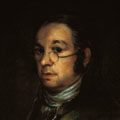
Estelle M. Hurll

The glory of Parma is the Cathedral, which represents the labors of many centuries. The building itself was begun in 1058, and completed in the thirteenth century. The interior was beautified by a succession of artists, one of whom was our painter Correggio. His work here was the decoration of the cupola, and he began it immediately upon finishing the frescoes in the church of S. Giovanni Evangelista.

In one of the pendentives of the cupola in the Parma Cathedral is the figure of St. John the Baptist reproduced in our illustration. The background is made to resemble somewhat the interior of a shell. On billows of clouds sits the prophet, with a lamb in his arms, and a circle of angels playing about him.

Almost every celebrated painter has at some time in his life sat for his portrait. Many have painted their own likenesses, not so much from motives of vanity, but as a matter of artistic interest. Others have posed as models to their fellow painters.

Correggio was an exception in this regard. The old biographer Vasari made many efforts to procure a portrait, and concluded that "he never took it himself, nor ever had it taken by others, seeing that he lived much in retirement."

In the northern part of Italy is the little town of Correggio, which gave its name to the painter whose works we are to study. His real name was Antonio Allegri, but in the sixteenth century a man would often be called by a nickname referring to some peculiarity, or to his birthplace. When Allegri went to Parma he was known as Antonio da Correggio, that is, Antonio from Correggio, and the name was then shortened to Correggio.

The story of Tobit is found in what is called the Apocrypha, that is, a collection of books written very much in the manner of the Bible, and formerly bound in Bibles between the Old and the New Testament.

The story goes that when Enemessar, King of Assyria, conquered the people of Israel, he led away many of them captive into Assyria, among them the family of Tobit, his wife Anna, and their son Tobias. They settled in Nineveh, and Tobit, being an honest man, was made purveyor to the king. That is, it was his business to provide food for the king's household.

Portrait Frontispiece. National Gallery, London. Signed and dated 1640.

1. Jacob Wrestling with the Angel. Berlin Gallery. Signed and dated 1659. Figures life size. Size: 4 ft. 5-1/16 in. by 3 ft. 9-5/8 in.

2. Israel Blessing the Sons of Joseph. Cassel Gallery. Signed and dated 1656. Figures life size. Size: 5 ft. 8-9/16 in. by 6 ft. 6-3/4 in.

The pictures we have examined thus far in this collection have been reproductions from Rembrandt's paintings. You will see at once that the picture of the Rat Killer is of another kind. The figures and objects are indicated by lines instead of by masses of color. You would call it a drawing, and it is in fact a drawing of one kind, but properly speaking, an etching. An etching is a drawing made on copper by means of a needle. The etcher first covers the surface of the metal with a layer of some waxy substance and draws his picture through this coating, or "etching ground," as it is called.

1606.[1] Rembrandt born in Leyden.

1621. Rembrandt apprenticed to the painter, Jacob van Swanenburch.

1624. Rembrandt studied six months with Pieter Lastman in Amsterdam.

1627. Rembrandt's earliest known works, St. Paul in Prison, (Stuttgart Museum); The Money Changers (Berlin Gallery).

1631. Rembrandt removed to Amsterdam.

1631. The Presentation painted.

1632. The Anatomy Lecture painted.

1633. The portrait of the Shipbuilder and his Wife painted.

1634. Rembrandt married Saskia van Uylenborch, June 22, in Bildt.

Ever since the beginning of human history there have been people who puzzled their brains about the reasons of things. Why things are as they are, whence we came, and whither we are going are some of the perplexing questions they have tried to answer. Some men have given all their lives to the study of these problems as a single occupation or profession. Among the ancient Greeks, who were a very intellectual nation, such men were quite numerous and were held in great esteem as teachers.

Frederick Henry of Orange, stadtholder, 1625. Princess Amalia of Solms, wife of Frederick Henry, built the Huis ten Bosch (House in the Woods) at the Hague, 1647.

William II of Orange, stadtholder, 1647. In 1650 the stadt-holderate was suppressed, and John de Witt became in 1653 chief executive of the republic for twenty years. Murdered in 1672.

John of Barneveld, Grand Pensioner, "the greatest statesman in all the history of the Netherlands" (Griffis). Executed May 24, 1619.

Michael de Ruyter, "the Dutch Nelson," died 1676.

Syndicate content