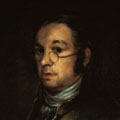
Estelle M. Hurll

Of all the sibyls, the one we hear most about is the Cumæan. The legend runs that, having asked a boon of Apollo, she gathered a handful of sand and said, "Grant me to see as many birthdays as there are sand grains in my hand." The wish was gratified, but unluckily she forgot to ask for enduring youth, so she was doomed to live a thousand years in a withered old age. Thus we always think of her as an old woman, as Michelangelo has represented her.

The statue of Lorenzo de' Medici is the central figure on the tomb erected to the memory of this prince. He was the rather unworthy namesake of his illustrious grandfather, who was known as Lorenzo the Magnificent. The Medici family was for many generations the richest and most powerful in Florence. They were originally merchants, and, as the name signifies, physicians, and, accumulating great wealth, they became powerful leaders, and really the rulers of the republic.

The tomb of Giuliano de' Medici is the companion to the tomb of Lorenzo, and stands on the opposite side of the altar which separates them. Our illustration shows the entire work, the statue being in the niche above, and the sarcophagus standing below with two reclining figures on it.

Florentine Dukes:

Lorenzo de' Medici, 1469-1492.

Piero de' Medici succeeded Lorenzo 1492, expelled from Florence 1493.

Alessandro de' Medici, made first hereditary duke of Florence 1531, assassinated 1537.

Cosimo de' Medici succeeded Alessandro, 1537-1574.

Popes:

Sixtus IV., 1471-1484.

Innocent VIII., 1484-1492.

Alexander VI., 1492-1503.

Pius III., 1503-1503.

Julius II., 1503-1513.

There are in the Bible certain references to a great day when the Son of Man shall be seen "coming in the clouds with great power and glory." "And he shall send his angels with a great sound of a trumpet, and they shall gather together his elect from the four winds, from one end of heaven to the other."[35] St.

Boiardo, 1434-1494, poet (Orlando Innamorato).

Ariosto, 1474-1533, poet (Orlando Furioso).

Aretino (Venetian) 1492-1557, poet.

Francesco Berni, 1496-1535, burlesque poet.

Bandello, 1480-1562, novelliero.

Sannazaro, 1458-1530, poet (Arcadia).

Niccolo Machiavelli, 1469-1527, author of The Prince.

Gucciardini, 1483-1540, historian.

Tasso, 1544-1595, poet (Gerusalemme Liberata).

In the pictures of this collection we have learned something of the work of Michelangelo as a sculptor and a painter. He was an artist whose personality was so strongly impressed upon his work that we have come thus to know, to a certain extent, the man himself. His, as we have seen, was not a happy nature, and many of the circumstances of his life conspired against his happiness.

Cristoforo Landino, 1424-1504, tutor of Lorenzo, and professor of Latin Literature.

Bartolommeo Scala, 1430-1497, chancellor of Florence.

Luigi Pulci, 1431-1487, writer of burlesque epic Il Morgante Maggiore, and intimate friend of Lorenzo and Poliziano.

Marsilio Ficino, 1433-1499, president of Academy in 1463, translator of Plato and Plotinus.

Angelo Poliziano, 1454-1494, tutor of Lorenzo's children, and professor of Greek and Latin Literature in University of Florence.

Michelangelo's place in the world of art is altogether unique. His supremacy is acknowledged by all, but is understood by a few only. In the presence of his works none can stand unimpressed, yet few dare to claim any intimate knowledge of his art. The quality so vividly described in the Italian word terribilità is his predominant trait. He is one to awe rather than to attract, to overwhelm rather than to delight.

Syndicate content