Painting

In July of 1904 the eighty-seven mortal years of George Frederick Watts came to an end. He had outlived all the contemporaries and acquaintances of his youth; few, even among the now living, knew him in his middle age; while to those of the present generation, who knew little of the man though much of his work, he appeared as members of the Ionides family, thus inaugurating the series of private and public portraits for which he became so famous. The Watts of our day, however, the teacher first and the painter afterwards, had not yet come on the scene.

Having given in the preceding pages the briefest possible outline of the life of Watts as a man amongst men, we are now able to come to closer quarters. He was essentially a messenger—a teacher, delivering to the world, in such a manner that his genius and temperament made possible, ideas which had found their place in his mind. He would have been the first to admit that without these ideas he would be less than nothing.

Failing the "Progress of the Cosmos," we have from the mind and brush of Watts a great number of paintings, which may be grouped according to their character. Such divisions must not be regarded as rigid or official, for often enough a picture may belong to several groups at the same time. For the purpose of our survey, however, we divide them as follows:

by Estelle M. Hurll

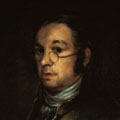
In the city of Florence, Italy, there is a famous gallery of portraits unlike any other collection of pictures in the world. It consists of the portraits of artists, painted by their own hands, and includes the most celebrated painters of all nations, from the fifteenth century to the present time. Here may be seen the portraits of Velasquez, Titian, Tintoretto, Rembrandt,—the world's greatest portrait painters,—and in the same splendid company hangs the portrait of Reynolds, reproduced in our frontispiece.

Somewhat over a century ago, at the time when our American colonies were struggling for liberty, lived the great English portrait painter, Sir Joshua Reynolds. In those days photography had not been invented, and portrait painting was a profession patronized by all classes of people. There were many portrait studios in London, but none were so fashionable as that of Reynolds.

The name of Sir Joshua Reynolds holds a place of honor among the world's great portrait painters. To appreciate fully his originative power one must understand the disadvantages under which he worked. His technical training was of the meagrest kind, and all his life he was hampered by ignorance of anatomy. But on the other hand he combined all those peculiar qualities of the artist without which no amount of technical skill can produce great portrait work.

There was once on the throne of England a king named Henry VIII. He was a man of extraordinary character, with qualities both good and bad. His conduct was sometimes unscrupulous and tyrannical, and he let nothing interfere with his own pleasure. Nevertheless his reign brought many benefits to England, and his memory is respected by English people.

THE original biographical material on the subject of Reynolds was supplied by his own contemporaries. His friend Malone wrote a valuable Memoir (1804), and his pupil Northcote furnished the first biography of the painter, the Life of Reynolds in two volumes published in 1813. A half century later (1865) was published the most comprehensive work on Reynolds in two large volumes by C. R. Leslie and T. Taylor. At about the same time (1866) appeared a book by F. G. Stephens, "English Children as painted by Sir Joshua Reynolds."

A pretty story is told of a Roman matron named Cornelia, who was one day entertaining a visitor, when the conversation led to the subject of jewels. "These are my jewels," said the hostess, and turned to show the stranger her beautiful children. The story comes readily to mind as one looks at this portrait of Lady Cockburn and her Children. Indeed, the picture was once engraved[7] under the fanciful title of "Cornelia and her Children." Like the Roman matron of old, the English mother gathers her children about her as the choicest jewels of her possession.

Syndicate content