


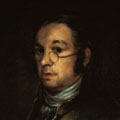



David Teniers the elder, who was born at Antwerp in 1582, received the first rudiments of his art from Rubens, who soon perceived in him the happy advances towards excelling in his profession that raised him to the head of his school. The prejudice in favour of his son, David Teniers the younger, is so great that the father is generally esteemed but a middling painter; and his pictures not worth the inquiry of a collector. His hand is so little distinguished, however, that the paintings of the father are often taken for those of the son. The father was certainly the inventor of the manner, which the son, who was his pupil, only improved with what little was wanting to perfection.
Rubens was astonished at his early success, and though he followed the manner of Adrian Brouwer, looked on him as his most deserving pupil by the brightness of genius that he showed. He soon saved enough money to undertake the journey to Italy, and when at Rome he established himself with Adam Elsheimer, who was then in great vogue. In Elsheimer's manner he soon became a perfect master, without neglecting at the same time the study of other and greater masters, endeavouring to penetrate into the deepest mysteries of their practice. An abode of ten years in Italy, and the influence of Elsheimer combined with that of Rubens, formed him into what he became.
When he returned to his own country he employed himself entirely in painting small pictures filled with figures of people drinking and merry-making, and numbers of peasants and country women. He displayed so much taste in these that the demand for them was universal. Even Rubens thought them an ornament to his collection.
Teniers drew his own character in his pictures, and in the subjects he usually expressed everything tends to joy and pleasure. Always employed in copying after nature whatsoever presented itself, he taught his two sons, David and Abraham, to follow his example, and accustomed them to paint nothing but from that infallible model, by which means they both became excellent painters. These were his only disciples, and he died at Antwerp in 1649.
The only distinction between his works and those of his son, David Teniers the younger, is that in the latter you discover a finer touch, a fresher brush, a greater choice of attitudes, and a better disposition of the figures. The father, too, retained something of the tone of Italy in his colouring, which was stronger than his son's; but his pictures have less harmony and union—though to tell the truth, when the father took pains to finish his picture, he very nearly resembled his son.
The latter, David Teniers the younger, was born in 1610. He was nicknamed the Ape of painting, from his powers of imitation. The Archduke Leopold William made him a gentleman of his bedchamber, and he made copies of all his pictures. He came to England to buy several Italian pictures for Count Fuensaldegna, who on his return heaped favours upon him. Don John of Austria and the King of Spain set so great a value upon his pictures that they built a gallery set apart to preserve them—there are no less than fifty-two in the Prado Gallery to-day.
His principal talent was landscape adorned with small figures. He painted men drinking and smoking, alchemists, corps de garde, temptations of S. Anthony, and country fairs and merry-makings. His small pictures are superior to his large ones. His execution displays the greatest ease; the leafing of his trees is light, his skies are admirable: his small figures have an exquisite expression and a most lively touch, and the characters are marked out with the greatest truth. From the thinness of the colours his works seem to have been finished at once; they are generally clear in all their parts, and Teniers had the art, without dark shades, to relieve his lights by other lights, so well managed as to produce the effect he wanted, an art which few besides himself have attained. He died at Antwerp in 1694.
Frans Snyders was born at Antwerp in the year 1587, ten years later, that is to say, than Rubens. He received his first instruction in the art of painting from Henry van Balen. His genius at first displayed itself only in painting fruit. He afterwards attempted animals, in which kind of study he succeeded so well that he surpassed all that had ever excelled before him. He stayed for some time in Italy, and the works he met with there by Castiglione proved a spur to his genius to attempt outdoing him in painting animals. When he returned to Flanders he fixed his ordinary abode at Brussels, where he was made painter to the Archduke and Duchess, and became attached to the house of Spain. Twenty-two of his pictures are in the Prado Gallery.
When Snyders required large figures in his compositions both Rubens and Jordaens took pleasure in assisting him, and Rubens in turn borrowed the assistance of Snyders to paint the ground of his pictures; thus they mutually assisted each other in their labours, while Snyders' manly and vigorous manner was quite able to hold its own even when joined with that of the great master.
Anthony van Dyck was born at Antwerp in 1599, less than three months before Velasquez at Seville. Both became so famous in their capacity of Court painters that the rest of their achievement is popularly regarded as little more than a bye-product.
In the case of Van Dyck there is the more excuse for the English public, inasmuch as, like Holbein before him, he was exclusively employed while in this country in the production of portraits; and as "his works are so frequent in England," as Horace Walpole observes in the opening sentence of his memoir in the "Anecdotes of Painting," "that the generality of our people can scarce avoid thinking him their countryman," it is easy enough to forget that he only spent the last nine years of his life here.
Again, the insatiable craze of the English and American public for portraits has helped to obscure the extent of Van Dyck's capabilities in other directions, and while the National Gallery contains not a single subject-piece from his hand, more and more thousands are continually spent in the acquisition of more and more portraits. The bewitching Cupid and Psyche in Queen Mary's closet at Hampton Court, painted a year before his death, is scarcely known to exist!
At the same time it would be useless to deny that Van Dyck's principal claim to his place among the greatest masters rests chiefly upon portraiture. The point I wish to make is that portrait painting never yet made a great master, but that none but a great master ever became a great portrait painter; and so long as we are only permitted to see the particular achievement of the artist in our public galleries, so long is it likely that we shall continue to be flooded with mediocre likenesses of fashionable people by painters whose highest or whose only achievement they constitute. Anyone can write a "short story" for the cheaper sort of modern journal; only writers like Hardy, Stevenson, or Kipling can give us a masterpiece in little.
It was said that Rubens advised Van Dyck to devote himself to portraiture out of jealousy: but that is hardly in accordance with what we know of his generous nature. If the advice was given at all we may be sure that it was given in a friendly spirit. But there was something in the temperament of Van Dyck which peculiarly fitted him for the Court, apart from any question as to his excellence in any particular branch of his art, and it is evident that the personality of Rubens, and his connection with the rich and mighty of the earth, influenced him almost as much as did his art. How much he owed to Rubens, and how much Rubens owed to him in painting is a matter that is arguable. He had been several years with Van Balen before he entered the studio of Rubens, when eighteen years old, not as a pupil but as an assistant. Here he not only had the practical task of painting Rubens's compositions for him, in company with numerous others, but had also the advantage of studying the works of Titian and other of the great Italian masters in Rubens's famous collection. If the hand of Van Dyck is traceable in some of the pictures of Rubens at this period, so the spirit of Rubens is very obvious in those of Van Dyck. The chief thing to be remembered is that in these early days he was not painting portraits. His earliest works, in which the influence of Titian is perceptible as well as that of Rubens, are the Christ bearing the Cross, in S. Paul's at Antwerp, painted in 1618; the S. Sebastian at Munich, and the Christ Mocked, at Berlin. The familiar portrait of Cornelius van der Geest in the National Gallery, is one of his very earliest, probably before 1620. Again, on his first visit to Genoa, in 1621, on the advice of Rubens, his ambition was not to paint portraits, as on his second visit some years later, but to rival Rubens in the composition of great historical pieces. It was not until 1627, when he left behind him in Genoa the superb series of Balbi, Brignole-Sala, Cattaneo, and Lomellini portraits, and returned to Antwerp to undertake those such as the Le Roys at Hertford House, or the Beatrice de Cusance at Windsor, that he had really become a portrait painter. Even then, he was still determined not to yield to Rubens at Antwerp, and painted, amongst other subjects, the Rinaldo and Armida for Charles I. It was only at the solicitation of George Geldorp, a schemer as well as a painter, that he consented at length, in 1632, to come to England; and it was only the welcome afforded to him by Charles that induced him to settle here.
Two considerations of personal vanity may be suggested as actuating Charles to be specially indulgent to Van Dyck—an indulgence of which the results posterity should not omit to credit to the sad account of the martyr—first, that his father had failed to retain the painter in his service, and second, that Velasquez, who had made a sketch of him on his mad visit to Madrid in 1623, was then immortalising Philip. Velasquez being out of the question, why not Van Dyck! An excellent idea! Especially when instead of dwarfs, buffoons, and idiots, the English Court contained some exceedingly fine material besides the royal family for the artist to exercise his talent upon.
After this, Flanders knew Van Dyck no more, save for a year or two's sojourn from 1633-1635 when he painted one or two magnificent portraits, and then returned to England, where he died in 1641. With the death of Rubens the year before, Flemish painting had suffered another eclipse; and though Snyders lived till 1657, and Jordaens and the younger Teniers continued till late in the century, no fresh seedlings appeared, and the soil again became barren. Rubens and Van Dyck were both too big for the little garden—their growth overspread Europe.