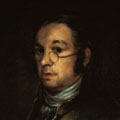
Estelle M. Hurll

Another of the Bible scenes which Raphael painted was one which is told in the New Testament concerning the Lord Jesus and his Apostles. Some of these, as Peter and Andrew, James and John, were fishermen who lived near the lake of Gennesaret in Galilee, and had spent most of their lives in their boats. They had been much with their Master, and sometimes left their boats to go with him through the country, when he talked with them and healed the sick, and told the glad tidings, for that is what the word Gospel means.

Portrait frontispiece. Painted on wood, 1506, as a gift from the painter to his uncle, Simone Ciarla, of Urbino. In 1588 the portrait passed from Urbino to the Academy of St. Luke, Rome. Later it was sold to Cardinal Leopoldo de' Medici for the Hall of Portraits of the Old Masters in the Uffizi Gallery, Florence.

Almost every celebrated painter has at some time in his life sat for his portrait. Many have painted their own likenesses, not so much from motives of vanity, but as a matter of artistic interest. Others have posed as models to their fellow painters.

Correggio was an exception in this regard. The old biographer Vasari made many efforts to procure a portrait, and concluded that "he never took it himself, nor ever had it taken by others, seeing that he lived much in retirement."

In the northern part of Italy is the little town of Correggio, which gave its name to the painter whose works we are to study. His real name was Antonio Allegri, but in the sixteenth century a man would often be called by a nickname referring to some peculiarity, or to his birthplace. When Allegri went to Parma he was known as Antonio da Correggio, that is, Antonio from Correggio, and the name was then shortened to Correggio.

The art of Correggio was very justly summed up by his first biographer, Vasari.

The first biographer of Correggio was Vasari, in whose "Lives of the Painters, Sculptors, and Architects" is included a brief account of this painter. The student should read this work in the last edition annotated by E. H. and E. W. Blashfield and A. A. Hopkins. Passing over the studies of the intervening critics, Julius Meyer's biography may be mentioned next, as an authoritative work, practically alone in the field for some twenty-five years. This was translated from the German by M. C. Heaton, and published in London in 1876.

Portrait frontispiece. From a photograph of an alleged portrait of Correggio in the Parma Gallery.

1. The Holy Night.(La Notte.) (Detail.) Painted at the order of Alberto Pratoneri for the altar of his chapel in the church of S. Prospero, Reggio. Agreement signed October 10, 1522. Stolen from the church May, 1640, and taken to Modena. Now in the Dresden Gallery. Size of whole picture: 8 ft. 5 in. by 6 ft. 2 in.

In the time of Correggio the convent of S. Paolo (St. Paul) in Parma was in charge of the abbess Giovanna da Piacenza, who had succeeded an aunt in this office in 1507. She was a woman of liberal opinions, who did not let the duties of her position entirely absorb her. She still retained some social connections and was a patroness of art and culture. The daughter of a nobleman, she was a person of consequence, whose private apartments were such as a princess might have. Already a well known painter of the day had decorated one of her rooms when she heard of the rising artist Correggio.

by Estelle M. Hurll

Compiled from Ricci's Correggio, to which the references to pages apply.

1494. Antonio Allegri born at Correggio.

1511-1513. Probably in Mantua (p. 69).

1515. Madonna of St. Francis (p. 94).

1518. In Parma executing the frescoes of San Paolo, April-December (p. 152).

1520. Invitation to Parma from the Benedictines (p. 153). Marriage with Girolama Merlini (p. 185).

Syndicate content