Estelle M. Hurll

Holland, as is well known, is a country built upon marshes, which have been drained and filled in by the patient industry of many generations of workers. The land is consequently very low, almost perfectly level, and is covered by a network of canals. It lacks many of the features which make up the natural scenery of other countries,—mountains and ravines, rocks and rivers,—but it is, nevertheless, a very picturesque country. Artists love it for the quiet beauty of its landscape. Though this is not grand and awe-inspiring, it is restful and attractive.

The choice of pictures for this collection has been made with the object of familiarizing the student with works fairly representative of Rembrandt's art in portraiture and Biblical illustration, landscape and genre study, in painting and etching. Admirers of the Dutch master may miss some well-known pictures. For obvious reasons the Lecture in Anatomy is deemed unsuitable for this place, and the Hundred Guilder Print contains too many figures to be reproduced here clearly.

In studying the fifteen pictures of this collection, we have seen something of the work of the great Dutch master, Rembrandt, and have learned a little of the man himself, of his love for the sweet wife, Saskia, of his friendship with the cultured burgomaster, Jan Six, of his faithful and reverent study of the Bible, of his rare insight into people's character. We are ready now to look directly into the artist's own face, in a portrait by his own hand.

The history of the Old Testament patriarch Jacob reads like a romance. He was the younger of the two sons of Isaac, and was at a great disadvantage on this account. Among his people the eldest son always became the family heir and also received the choicest blessing from the father, a privilege coveted as much as wealth. In this case therefore the privileged son was Jacob's brother Esau. Jacob resented keenly the inequality of his lot; and his mother sympathized with him, as he was her favorite.

A general impression prevails with the large picture-loving public that a special training is necessary to any proper appreciation of Rembrandt. He is the idol of the connoisseur because of his superb mastery of technique, his miracles of chiaroscuro, his blending of colors. Those who do not understand these matters must, it is supposed, stand quite without the pale of his admirers. Too many people, accepting this as a dictum, take no pains to make the acquaintance of the great Dutch master. It may be that they are repelled at the outset by Rembrandt's indifference to beauty.

When Jacob wrestled with the angel he received a new name, Israel, or a prince, a champion of God.

The history of modern Rembrandt bibliography properly begins with the famous work by C. Vosmaer, "Rembrandt Harmens van Rijn, sa Vie et ses Œuvres." Vosmaer profited by the researches of Kolloff and Burger to bring out a book which opened a new era in the appreciation of the great Dutch master. It was first issued in 1868, and was republished in 1877 in an enlarged edition. This book was practically alone in the field until the recent work of Emile Michel appeared.

The story of Tobit is found in what is called the Apocrypha, that is, a collection of books written very much in the manner of the Bible, and formerly bound in Bibles between the Old and the New Testament.

The story goes that when Enemessar, King of Assyria, conquered the people of Israel, he led away many of them captive into Assyria, among them the family of Tobit, his wife Anna, and their son Tobias. They settled in Nineveh, and Tobit, being an honest man, was made purveyor to the king. That is, it was his business to provide food for the king's household.

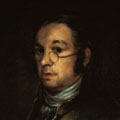
Portrait Frontispiece. National Gallery, London. Signed and dated 1640.

1. Jacob Wrestling with the Angel. Berlin Gallery. Signed and dated 1659. Figures life size. Size: 4 ft. 5-1/16 in. by 3 ft. 9-5/8 in.

2. Israel Blessing the Sons of Joseph. Cassel Gallery. Signed and dated 1656. Figures life size. Size: 5 ft. 8-9/16 in. by 6 ft. 6-3/4 in.

The pictures we have examined thus far in this collection have been reproductions from Rembrandt's paintings. You will see at once that the picture of the Rat Killer is of another kind. The figures and objects are indicated by lines instead of by masses of color. You would call it a drawing, and it is in fact a drawing of one kind, but properly speaking, an etching. An etching is a drawing made on copper by means of a needle. The etcher first covers the surface of the metal with a layer of some waxy substance and draws his picture through this coating, or "etching ground," as it is called.

Syndicate content