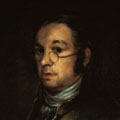
Painting

Portrait Frontispiece. National Gallery, London. Signed and dated 1640.

1. Jacob Wrestling with the Angel. Berlin Gallery. Signed and dated 1659. Figures life size. Size: 4 ft. 5-1/16 in. by 3 ft. 9-5/8 in.

2. Israel Blessing the Sons of Joseph. Cassel Gallery. Signed and dated 1656. Figures life size. Size: 5 ft. 8-9/16 in. by 6 ft. 6-3/4 in.

The pictures we have examined thus far in this collection have been reproductions from Rembrandt's paintings. You will see at once that the picture of the Rat Killer is of another kind. The figures and objects are indicated by lines instead of by masses of color. You would call it a drawing, and it is in fact a drawing of one kind, but properly speaking, an etching. An etching is a drawing made on copper by means of a needle. The etcher first covers the surface of the metal with a layer of some waxy substance and draws his picture through this coating, or "etching ground," as it is called.

1606.[1] Rembrandt born in Leyden.

1621. Rembrandt apprenticed to the painter, Jacob van Swanenburch.

1624. Rembrandt studied six months with Pieter Lastman in Amsterdam.

1627. Rembrandt's earliest known works, St. Paul in Prison, (Stuttgart Museum); The Money Changers (Berlin Gallery).

1631. Rembrandt removed to Amsterdam.

1631. The Presentation painted.

1632. The Anatomy Lecture painted.

1633. The portrait of the Shipbuilder and his Wife painted.

1634. Rembrandt married Saskia van Uylenborch, June 22, in Bildt.

Ever since the beginning of human history there have been people who puzzled their brains about the reasons of things. Why things are as they are, whence we came, and whither we are going are some of the perplexing questions they have tried to answer. Some men have given all their lives to the study of these problems as a single occupation or profession. Among the ancient Greeks, who were a very intellectual nation, such men were quite numerous and were held in great esteem as teachers.

Frederick Henry of Orange, stadtholder, 1625. Princess Amalia of Solms, wife of Frederick Henry, built the Huis ten Bosch (House in the Woods) at the Hague, 1647.

William II of Orange, stadtholder, 1647. In 1650 the stadt-holderate was suppressed, and John de Witt became in 1653 chief executive of the republic for twenty years. Murdered in 1672.

John of Barneveld, Grand Pensioner, "the greatest statesman in all the history of the Netherlands" (Griffis). Executed May 24, 1619.

Michael de Ruyter, "the Dutch Nelson," died 1676.

The story of the Good Samaritan was related by Jesus to a certain lawyer as a parable, that is, a story to teach a moral lesson. The object was to show what was true neighborly conduct; and this was the story:—[6]

Flemish:—

  • Peter Paul Rubens, 1577-1640.
  • Anthony Van Dyck, 1599-1641.
  • Jacob Jordaens, 1594-1678.
  • Franz Snyders, 1574-1657.
  • Gaspard de Craeyer, 1582-1669.
  • David Teniers, 1610-1690.

Spanish:—

  • Velasquez, 1599-1660.
  • Pacheco, 1571-1654.
  • Cano, 1601-1676.
  • Herrera, 1576-1656.
  • Zurbaran, 1598-1662.
  • Murillo, 1618-1682.

French:—

The story which the picture of the Presentation illustrates is a story of the infancy of Jesus Christ. According to the custom of the Jews at that time, every male child was "presented," or dedicated, to the Lord when about a month old. Jesus was born in Bethlehem of Judæa, a small town about four miles from the city of Jerusalem, the Jewish capital, where the temple was. When he was about a month old, his mother Mary and her husband Joseph, who were devout Jews, brought him to the great city for the ceremony of the presentation in the temple.

We read in the evangelists' record of the life of Jesus that he went about the country preaching the gospel (or the good news) of the kingdom of Heaven. Sometimes he preached in the synagogue on the Sabbath day; but more often he talked to the people in the open air, sometimes on the mountain-side, sometimes on the shore of the lake Gennesaret, or again in the streets of their towns.

The picture of Christ at Emmaus illustrates an event in the narrative of Christ's life which took place on the evening of the first Easter Sunday. It was now three days since the Crucifixion of Christ just outside Jerusalem, and the terrible scene was still very fresh in the minds of his disciples. It happened that late in the day two of them were going to a village called Emmaus, not very far from Jerusalem.

Syndicate content