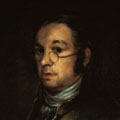
Painting

David Teniers the elder, who was born at Antwerp in 1582, received the first rudiments of his art from Rubens, who soon perceived in him the happy advances towards excelling in his profession that raised him to the head of his school. The prejudice in favour of his son, David Teniers the younger, is so great that the father is generally esteemed but a middling painter; and his pictures not worth the inquiry of a collector.

In the preceding chapters we have traced the development of painting for five centuries—from the beginning of the fourteenth, that is to say, to the end of the eighteenth—in Italy, in the Netherlands, in Germany, in Spain, and lastly in France and England. In the nineteenth the story is confined to the last two alone, as with one or two minute exceptions the art of painting had by this time entirely ceased to be worth consideration in any of the others.

By the will of God, in the year 1240, we are told by Vasari, Giovanni Cimabue, of the noble family of that name, was born in the city of Florence, to give the first light to the art of painting.

It has often been said that in Chinese painting, as in Japanese painting, perspective is ignored. Nothing is further from the truth. This error arises from the fact that we have confused one system of perspective with perspective as a whole. There are as many systems of perspective as there are conventional laws for the representation of space.

The Chinese divide the subjects of painting into four principal classes, as follows:
Landscape.
Man and Objects.
Flowers and Birds.
Plants and Insects.

Nowhere do we see a predominant place assigned to the drawing or painting of the human figure. This alone is sufficient to mark the wide difference between Chinese and European painting.

The aesthetic conceptions of the Far East have been deeply influenced by a special philosophy of nature. The Chinese consider the relation of the two principles, male and female, the yang and the yin, as the source of the universe. Detached from the primordial unity, they give birth to the forms of this world by ever varying degrees of combination. Heaven corresponds to the male principle, earth to the female principle.

The origins of painting in China are mingled with the origins of writing. Written characters are, in fact, derived from pictography or picture writing, those in use at the present time being only developed and conventionalized forms of primitive drawings. The early books and dictionaries give us definite information regarding this evolution.

Syndicate content