Printing

Success in printing depends very much on care and orderliness. It is necessary to keep to a fixed arrangement of the position of everything on the work-table and to have all kept as clean as possible. To see the deft and unhurried work of a Japanese craftsman at printing is a great lesson, and a reproach to Western clumsiness.

The positions indicated by the diagram on page 11 will be found to be practical and convenient.

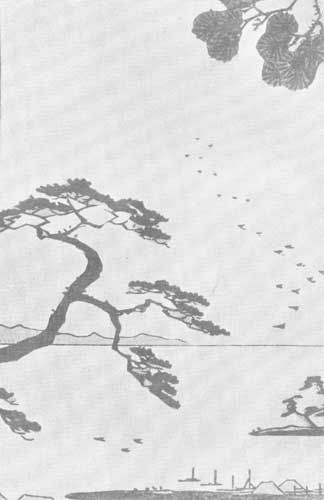
With practice the knife soon becomes an easy and a very precise tool, capable of great expressiveness in drawing. Bear in mind that both sides of a line are drawn by the knife. The special power of developing the expressive form of line on both sides is a resource tending to great development of drawing in designs for wood-block prints. The line may be of varying form, changing from silhouette to pure line as may best serve to express the design. It should never be a mere diagram.

As made by the Japanese, the baren is about five inches in diameter, and consists of a circular board upon which a flat coil of cord or twisted fibre is laid. This is held in place by a covering made of a strip of bamboo-sheath, the two ends of which are twisted and brought together at the back of the board so as to form a handle. The flat surface of the bamboo-sheath is on the under side of the pad when the handle is uppermost.

When this is done all the sheets will have received a single impression, which may be either a patch of colour or an impression in line of part of the design of the print. The block A is then removed, cleaned, and put away; and the block for the second impression put in its place.

It is usual to print the line or key-block of a design first, as one is then able to detect faulty registering or imperfect fitting of the blocks and to correct them at once. But there are cases in which a gradated tone, such as a sky, may need to be printed before the line block.

Syndicate content