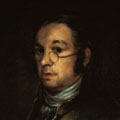
Bernhard Berenson

Psychology has ascertained that sight alone gives us no accurate sense of the third dimension. In our infancy, long before we are conscious of the process, the sense of touch, helped on by muscular sensations of movement, teaches us to appreciate depth, the third dimension, both in objects and in space.

In the same unconscious years we learn to make of touch, of the third dimension, the test of reality. The child is still dimly aware of the intimate connection between touch and the third dimension.

Andrea, 1308(?)-1368. Pupil of Andrea Pisano; follower of Giotto; influenced by Ambrogio Lorenzetti of Siena.

Of the brothers, Nardo, who died in 1365, was scarcely his inferior.

The only painting certainly from Andrea’s hand is the altarpiece at S. Maria Novella. The frescoes in the same church are probably by Nardo.

Uccello, as I have said, was the first representative of two strong tendencies in Florentine painting—of art for dexterity’s sake, and art for scientific purposes. Andrea del Castagno, while also unable to resist the fascination of mere science and dexterity, had too much artistic genius to succumb to either. He was endowed with great sense for the significant, although, it is true, not enough to save him completely from the pitfalls which beset all Florentines, and even less from one more peculiar to himself—the tendency to communicate at any cost a feeling of power.

It is a temptation to hasten on from Pollaiuolo and Verrocchio to Botticelli and Leonardo, to men of genius as artists reappearing again after two generations, men who accomplished with scarcely an effort what their precursors had been toiling after.

Michelangelo had a sense for the materially significant as great as Giotto’s or Masaccio’s, but he possessed means of rendering, inherited from Donatello, Pollaiuolo, Verrocchio and Leonardo,—means that had been undreamt of by Giotto or even by Masaccio. Add to this that he saw clearly what before him had been felt only dimly, that there was no other such instrument for conveying material significance as the human nude. This fact is as closely dependent on the general conditions of realising objects as tactile values are on the psychology of sight.

1502(?)-1572. Pupil of Pontormo; influenced by Michelangelo.

  • Assisi.
    • S. Francesco, Lower Church, Over Tomb of Saint. Frescoes: Allegories of Poverty, Chastity, and Obedience, and Triumph of St. Francis. (The Francis between the two Angels in the “Obedience” and nearly all of the “Triumph” were executed by another hand, probably C.)
      • R. Transept.

Well, it was of the power to stimulate the tactile consciousness—of the essential, as I have ventured to call it, in the art of painting—that Giotto was supreme master. This is his everlasting claim to greatness, and it is this which will make him a source of highest æsthetic delight for a period at least as long as decipherable traces of his handiwork remain on mouldering panel or crumbling wall.

  • Berlin.
    • Von Kaufmann Collection. Head of female Saint.
  • Florence.
    • Bargello. 139. Angel playing Viol.
    • Or San Michele. Tabernacle. Finished 1359.
Syndicate content