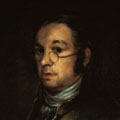
Bernhard Berenson

Florentine painting between Giotto and Michelangelo contains the names of such artists as Orcagna, Masaccio, Fra Filippo, Pollaiuolo, Verrocchio, Leonardo, and Botticelli. Put beside these the greatest names in Venetian art, the Vivarini, the Bellini, Giorgione, Titian, and Tintoret. The difference is striking. The significance of the Venetian names is exhausted with their significance as painters. Not so with the Florentines. Forget that they were painters, they remain great sculptors; forget that they were sculptors, and still they remain architects, poets, and even men of science.

1475-1564. Pupil of Ghirlandaio; influenced by the works of Jacopo della Quercia, Donatello, and Signorelli.

Fra Angelico we know already as the painter who devoted his life to picturing the departing mediæval vision of a heaven upon earth. Nothing could have been farther from the purpose of Uccello and Castagno. Different as these two were from each other, they have this much in common, that in their works which remain to us, dating, it is true, from their years of maturity, there is no touch of mediæval sentiment, no note of transition.

About 1400-1461. Probably acquired his rudiments at Venice; formed under the influence of Donatello, Masaccio, and Fra Angelico.

In all that concerns movement, Verrocchio was a learner from Pollaiuolo, rather than an initiator, and he probably never attained his master’s proficiency. We have unfortunately but few terms for comparison, as the only paintings which can be with certainty ascribed to Verrocchio are not pictures of action. A drawing however like that of his angel, in the British Museum, which attempts as much movement as the Hercules by Pollaiuolo, in the same collection, is of obviously inferior quality.

Bronzino, Pontormo’s close follower, had none of his master’s talent as a decorator, but happily much of his power as a portrait-painter. Would he had never attempted anything else!

1420-1497. Pupil possibly of Giuliano Pesello, and of the Bicci; assistant and follower of Fra Angelico.

1276-1336. Follower of Pietro Cavallini; influenced by Giovanni Pisano.

The immense superiority of the artist even to his greatest achievement in any one art form, means that his personality was but slightly determined by the particular art in question, that he tended to mould it rather than let it shape him. It would be absurd, therefore, to treat the Florentine painter as a mere link between two points in a necessary evolution. The history of the art of Florence never can be, as that of Venice, the study of a placid development.

  • Berlin.
    • Small Marble Apollo.
  • Bologna.
    • S. Domenico. S. Petronio; An Angel (for Ark of St. Dominic). 1494.
  • Bruges.
    • Notre Dame. Madonna.
Syndicate content